DUSK After Dark
DUSK magazine profile on DEPO, a dark poster page. The full-screen cover carries a giant wordmark, back issues run sideways under the wheel, and a red open-call panel counts down to its deadline.
Every page we tried for DEPO, one post each: what it is, how it was built, how it looks.
65 demos
Scroll-driven scenes, depth, light and camera moves.
DUSK magazine profile on DEPO, a dark poster page. The full-screen cover carries a giant wordmark, back issues run sideways under the wheel, and a red open-call panel counts down to its deadline.
What DEPO does, told by one series: a person as they are, then make-up, then hair, then the magazine cover. The same four frames in four versions: aperture blades, a shutter you press, turning slats, and prints that land on a pile.
A nebula to breathe with: seven huge colour fields — azure, amethyst, violet, amber, blue haze — drift on slow sine curves, swell and fade on near-black, blurred so far that only colour remains, under a fine noise veil. No text, no controls.
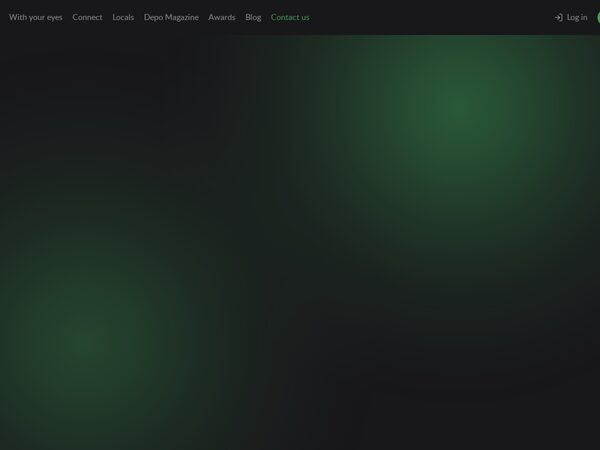
The live DEPO header and footer with two empty screens between them, so nothing covers the site's animated background — soft green spots that fade in, drift to new places and fade out. Every setting of the animation is exposed and documented, with live controls at ?tune.
The community as a constellation on a dark forest ground. Portraits and magazine covers circle the DEPO eye on two tilted rings that follow the pointer and the scroll, then unwrap into a grid of people. Choosing a role turns a second orbit; the close is a ring of faces.